
Many of the world’s most impactful innovations began at a point when they had no clearly defined market, generated no revenue, and had not even fully demonstrated their technical feasibility. At this stage, conventional financing methods, such as bank loans, often fail to meet a business’s needs; the company lacks sufficient physical assets to offer as collateral, while regular debt repayments are incompatible with the uncertainty inherent in its operations. Venture capital emerged to bridge precisely this gap.
Under this model, investors provide funding, managerial expertise, professional networks, and business development experience to teams with high growth potential despite the considerable risk of failure in exchange for an ownership stake in the company. Returns do not come from guaranteed profits, but from an increase in the company’s value and the subsequent sale of shares, mergers and acquisitions, or an initial public offering (IPO). Venture capital should therefore be understood as a long term partnership in building a business, rather than simply an injection of capital.
Today, this model has become a core component of the innovation ecosystem in many countries. According to the Organisation for Economic Co operation and Development (OECD), venture capital plays an important role in financing startups and innovative companies, particularly those whose value rests largely on intangible assets such as technology, practical knowledge, data, and intellectual property, and which consequently have limited access to bank financing. These companies can contribute to productivity growth, job creation, and the emergence of new industries.
The role of a venture capital investor is not the same across industries. In digital businesses, capital may be used primarily for product development, customer acquisition, and rapid market expansion. In sectors such as biotechnology and pharmaceuticals, however, investors must support a lengthy journey involving laboratory research, preclinical studies, clinical trials, regulatory approvals, and the development of manufacturing capacity. In these fields, it can take years for a scientific idea to reach the market as a product, with a risk of failure at every stage.
Successful pharmaceutical investment therefore requires more than funding: it calls for patient capital, scientific assessment, staged risk management, and active support for the team. A prominent example is the creation and growth of Moderna with the backing of Flagship Pioneering. Its experience illustrates how a high risk scientific hypothesis, combined with capital, knowledge, and a long term perspective, can evolve into a technology platform and ultimately a product with global impact.
From Venture Capital to High Impact Medicine: Lessons from Investing in Moderna
Developing a new drug is generally a lengthy, costly, and high risk process. Many scientific ideas are halted by a lack of funding, infrastructure, or management capabilities before reaching a stage at which they become attractive to major pharmaceutical companies. In this industry, venture capital is more than a financing tool; it is a means of turning scientific knowledge into a scalable business.
In the pharmaceutical industry, investors must accept lengthy research and development cycles, a high probability of study failure, complex regulatory requirements, and an ongoing need for capital. In return, a successful product can generate substantial financial returns while also delivering a far reaching impact on public health. Research published in Health Affairs Scholar shows that venture capital firms play an important role in funding biopharmaceutical R&D and building drug development pipelines by taking on high levels of risk, although the selection of therapeutic areas remains heavily influenced by their potential financial returns.
One prominent example of this model is Flagship Pioneering’s investment in the creation of Moderna. Moderna’s story did not begin with a market ready product. It began with a high risk scientific hypothesis: Could messenger RNA (mRNA) be used to instruct the body’s cells to produce therapeutic proteins?
In 2010, Flagship examined this idea within its internal organization and subsequently established a company initially named NewcoLS18, which later became Moderna. Moderna’s initial public offering documents filed with the U.S. Securities and Exchange Commission (SEC) also confirm that the company was originally founded by Flagship Pioneering (Moderna’s official SEC IPO filing). The investor therefore did not merely enter after the company had been formed; it also helped identify the scientific opportunity, build the organization, recruit the team, and shape its development path.
For years, Moderna invested substantial resources in developing its mRNA platform, establishing manufacturing infrastructure, and advancing research programs without having a commercial product. The company raised $450 million in 2015 and $500 million in 2018. These funds were used to advance the technology, expand research programs, and build manufacturing infrastructure for mRNA based products.
What is particularly noteworthy is that investment in Moderna was not focused on a specific drug; the goal was to build a “technology platform.” This platform could be used to develop a range of vaccines and therapies. Such an approach spreads risk across multiple therapeutic applications and, if the technology succeeds, prevents the company’s value from depending on a single product.
The COVID-19 pandemic became the defining test of this investment. The scientific and operational infrastructure built over roughly a decade enabled Moderna to develop its mRNA vaccine rapidly. This achievement, however, was not the result of private capital alone. Collaboration with institutions such as the U.S. National Institutes of Health, together with government support for vaccine development, manufacturing, and procurement, also played an essential role in its rapid commercialization. Moderna’s experience is, in fact, an example of the synergy between venture capital, academic knowledge, public support, and a company’s execution capabilities.
After obtaining the necessary authorizations, Moderna’s vaccine entered the market and received full approval from the U.S. Food and Drug Administration (FDA) in January 2022 under the name Spikevax. According to Moderna’s official filing with the SEC, the company’s COVID-19 vaccine sales reached $17.7 billion in 2021.
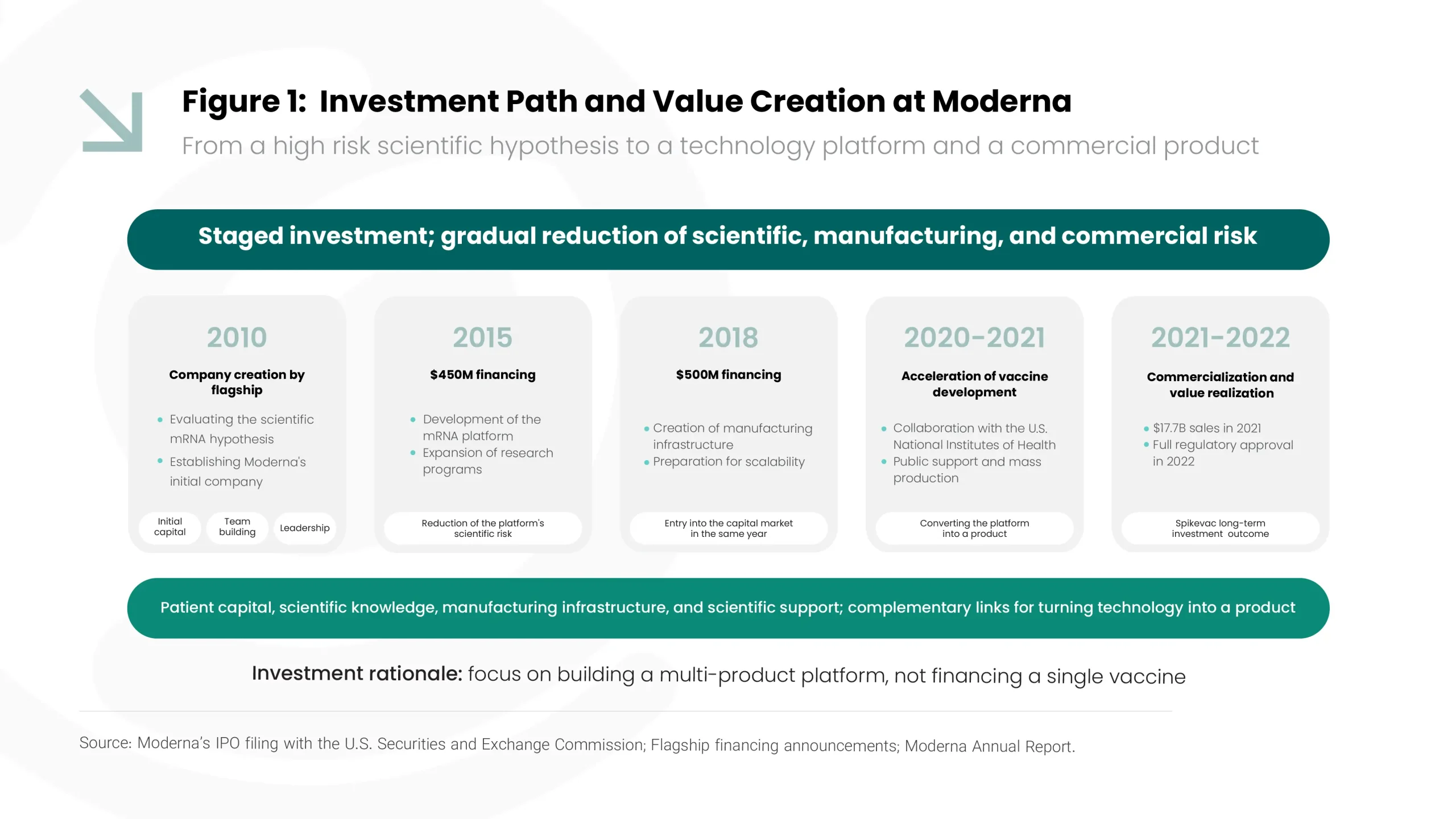
Perhaps the most important lesson from Moderna’s experience is that successful pharmaceutical investment does not necessarily begin by identifying a product that is close to market. Sometimes, the real advantage lies in recognizing a fundamental scientific capability, providing patient capital, assembling a complementary team, and building infrastructure that can withstand years of uncertainty. Financial capital is essential, but it is strategic support, a long term outlook, and the ability to turn science into an organization that bridge the gap between a laboratory hypothesis and a global product.
.
From Opportunity Identification to Manufacturing Infrastructure Development: Golrang Ventures’ Investment Story in the Pharmaceutical Industry
As the venture capital arm of Golrang Group, Golrang Ventures began identifying opportunities in the pharmaceutical industry by reviewing and holding discussions with various organizations. The objective was to identify a company that not only possessed technical know-how and R&D capabilities but also had the potential to become a scalable business in the pharmaceutical industry.
During this process, we were introduced to a company engaged in the development and manufacturing of active pharmaceutical ingredients (APIs), with the practical knowledge to produce approximately 20 active ingredients. Its diversified product portfolio and the team’s technical capabilities were among its strengths. However, the absence of a dedicated manufacturing facility was one of the most significant barriers to its growth.
The company relied on outsourcing to manufacture its products. While this arrangement could meet some short term production needs, it carried serious long term risks. Transferring manufacturing processes to third parties increased the risk of disclosing practical knowledge, the replication of manufacturing methods, and contract manufacturers entering the market with the same products. Moreover, dependence on other companies’ production capacity and schedules limited its control over quality, timing, and manufacturing scale.
The main challenge, therefore, was not simply to secure working capital or increase sales. It was to establish the infrastructure needed for the company to turn its practical knowledge into commercial products within an independent, controlled manufacturing environment.
 Product Evaluation and Development of the Future Portfolio
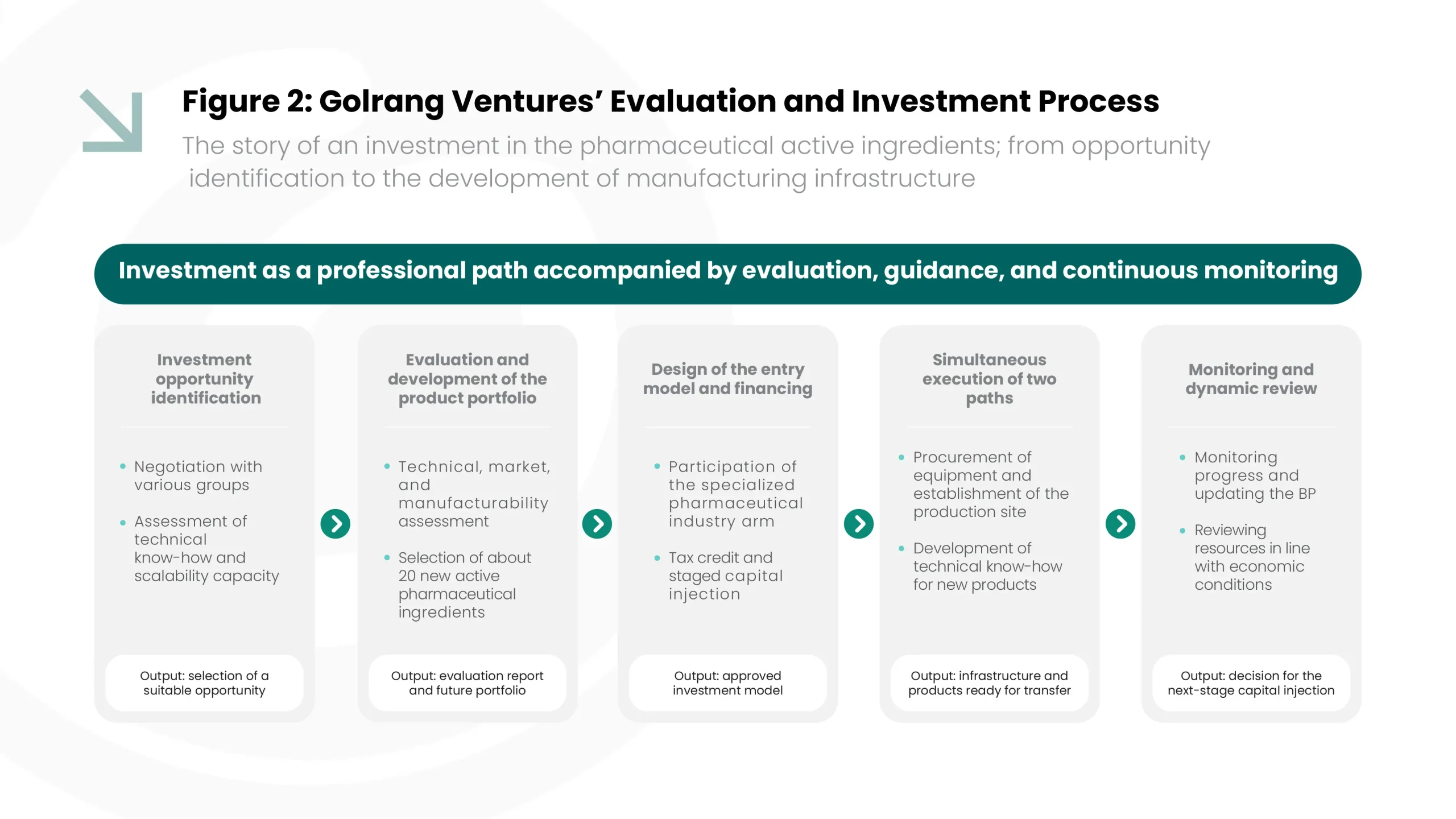
In the first stage, the company’s existing products were assessed from technical, market, manufacturability, and commercialization perspectives. At the same time, approximately 20 additional active pharmaceutical ingredients were selected for its future development portfolio. This selection aimed to diversify the product portfolio, enhance revenue generation potential, and make more effective use of the planned manufacturing facility.
Following the initial assessment, the proposal was presented to Golrang Ventures’ investment admission committee. Given the attractiveness of the sector, the company’s technical capabilities, and the strategic importance of manufacturing active pharmaceutical ingredients, the committee approved a more extensive and rigorous evaluation.
Next, the technical and financial aspects, market, team, product development plan, and requirements for establishing the manufacturing facility were reviewed in detail, and the final evaluation report was prepared. The proposal was then submitted to the investment committee and approved subject to certain revisions. The revised report was also presented to the board of directors for a final decision.
Designing the Investment Entry Model with the Specialized Pharmaceutical Arm
One important feature of this investment was its use of the Group’s in house specialized capabilities alongside national and government support. As one of our investment arms operates as a corporate venture capital (CVC) fund (Golrang Ventures Fund), and the Group also has a specialized pharmaceutical holding company, it was decided that the investment would proceed under the guidance of that holding company.
Accordingly, the evaluation report was shared with the pharmaceutical holding company, and the proposal was reviewed again from specialized and industry specific perspectives. Involving a strategic partner from the pharmaceutical industry helped ensure that decisions were based on more than financial indicators alone. Factors such as manufacturing feasibility, the quality of practical knowledge, market potential, regulatory requirements, and possible synergies were also incorporated into the investment model.
Following this stage, and in line with the board of directors’ decision, the investment was to proceed through the CVC arm using a tax credit mechanism. The proposal was submitted to the Vice Presidency for Science, Technology and Knowledge Based Economy, which also conducted an independent evaluation. After the proposal was approved and the tax credit allocated, preliminary approval was obtained and the first tranche of capital was injected.
Advancing Infrastructure and R&D in Parallel
Following financing, the portfolio company began implementation along two parallel tracks. On the first track, requests to purchase and procure the equipment required for the manufacturing facility were submitted as quickly as possible. On the second, R&D began on new active pharmaceutical ingredients that were intended to enter the company’s production line once the necessary practical knowledge had been developed.
This parallel approach ensured that the period spent building infrastructure did not become merely a waiting period for purchasing, delivering, and installing equipment. During the same period, the R&D team worked to complete the practical knowledge for new products, so that a suitable portfolio of products would be ready for transfer to the production line when the facility became operational.
Over two years, implementation progress, infrastructure development, and the development of product related practical knowledge were continuously monitored. The portfolio company’s manufacturing facility is now ready, and production will soon be transferred from outsourced contractors to the new site. In addition to increasing the company’s control over quality and production planning, this transition will enable better protection of practical knowledge and independent product development.
Investment as a Dynamic Process
Golrang Ventures’ experience in this sector demonstrated that an investment does not end when a contract is signed and the first tranche of funding is provided. Changing economic conditions, exchange-rate increases, and rising costs of equipment procurement and infrastructure development can alter a project’s initial assumptions. The financial model must therefore be updated throughout implementation.
In light of economic developments and rising investment costs, the company’s business plan was reviewed again. The results showed that completing its development plan under the new conditions would require additional financial resources. This was reassessed and, following board approval, a subsequent tranche of capital was placed on the agenda.
For us, investing in this company was an experience in providing sustained support to a knowledge based business. The journey began with selecting the opportunity and validating its practical knowledge; continued through collaboration with the specialized pharmaceutical arm and the use of the tax credit mechanism; and was completed through implementation monitoring and adjustments in response to economic conditions.
This experience shows that, in corporate venture capital, financial capital is only one component of value creation. Specialized evaluation, industry guidance, protection of practical knowledge, sound financing odel design, and flexibility in the face of changing external conditions can turn a technological capability into sustainable infrastructure for manufacturing and industrial development.
References
- 1. OECD. (2026). Financing SMEs and Entrepreneurs 2026: Leveraging Venture Capital for SMEs.
- 2. OECD. Start-up-driven innovation and growth.
- 3. Berger, M., OECD. (2024). What is the Role of Government Venture Capital for Innovation-Driven Entrepreneurship?
- 4. Kang, S. Y., et al. (2024). Biopharmaceutical pipeline funded by venture capital firms. Health Affairs Scholar, 2(10).
- 5. Moderna, Inc. (2018). Form S-1/A Registration Statement. U.S. Securities and Exchange Commission.
- 6. Flagship Pioneering. Moderna Timeline.
- 7. Flagship Pioneering. (2015). Moderna Closes $450 Million Financing to Support Growth of Messenger RNA Therapeutics Platform.
- 8. Flagship Pioneering. (2018). Moderna Closes $500 Million Equity Financing.
- 9. U.S. Food and Drug Administration. (2022). Spikevax: Approval Letter and Regulatory Documents.
- 10. Moderna, Inc. (2022). Annual Report for the Fiscal Year Ended December 31, 2021. U.S. Securities and Exchange Commission.