A look back at economic history reveals one recurring pattern: financing tools have continually evolved alongside the needs of society. From a time when trade relied entirely on barter to an era in which digital platforms can connect thousands of investors with businesses seeking capital in just a few clicks, every stage of economic development has called for financial instruments suited to its time.
As trade expanded, industries developed, and companies demand for capital grew, traditional financing methods could no longer response to every market need. New mechanisms emerged to aggregate and allocate capital, each filling part of that gap. Crowdfunding is one of the more recent outcomes of this evolution, a model that uses online platforms to enable smaller investors to participate in financing economic projects, narrowing the distance between capital providers and businesses seeking funding.
Iran has also seen significant growth in this model in recent years. Operating under the supervision of Iran Fara Bourse (IFB) and through licensed platforms, crowdfunding has become a new financing route for companies, particularly small and medium sized enterprises (SMEs). Its continued growth suggests that the model is gradually establishing a more defined place in the country’s financial system.
From Barter to Capital Markets
The history of financial systems shows that no financing instrument has completely replaced the ones that came before it. Instead, each emerged in response to the needs and constraints of its time. In early societies, transactions were based on barter, or the direct exchange of goods. While this worked in small economies, expanding trade and a wider variety of goods exposed major limitations, including the need for both parties wants to match at the same time and the difficulty of valuing different goods.
The advent of money reshaped the financial system, marking a major step in the evolution of modern finance. The use of precious metals and later standardized coins, made trade easier and gradually laid the groundwork for concepts such as saving, credit, and investment. As commerce expanded and businesses needed more capital, institutions such as banks and capital markets developed to mobilize and allocate funds in a more structured way.
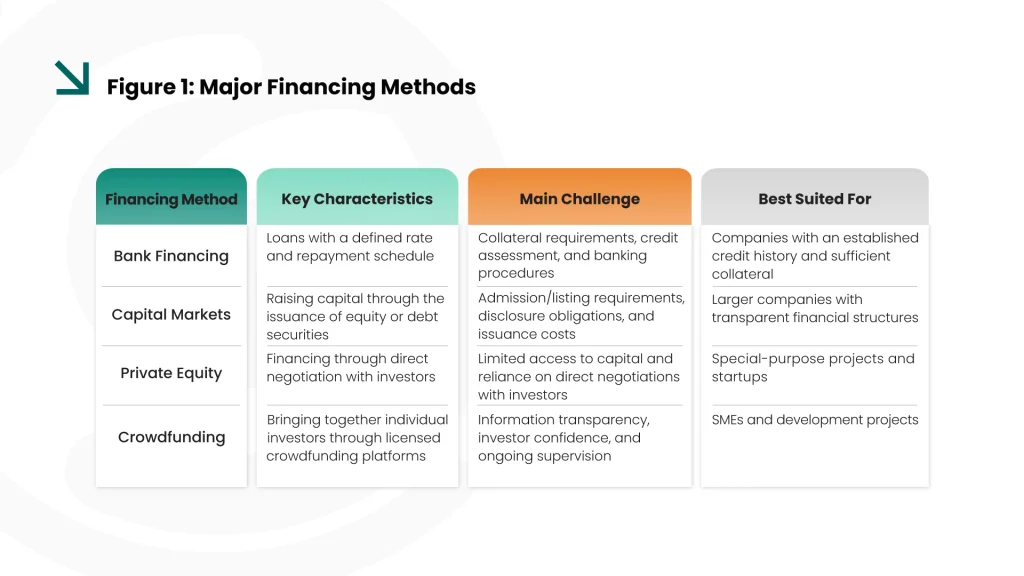
Despite the critical role of banks and stock exchanges in economic development, access to these channels has never been equal for every business. Bank financing typically requires collateral and specific, sometimes complex credit conditions, while entering capital markets involves regulatory, admission, and disclosure requirements. These constraints, especially for small, early stage, and innovative businesses, created room for alternative financing models, with crowdfunding becoming one of the most important among them.
Crowdfunding: A Complementary Link in the Financing Chain
Crowdfunding is not a replacement for banks or capital markets; it is a complementary for them. Digital platforms make it possible to aggregate individual investments and channel them toward economic projects, helping bridge part of the gap between investors and businesses seeking funding. For many SMEs that do not have easy access to bank loans or capital markets, crowdfunding has therefore become another viable route to finance growth.
In Iran, crowdfunding is predominantly structured as debt-based crowdfunding, with investors participating in the returns generated by funded projects. Companies raise the capital they need for working capital or development initiatives through licensed platforms, while investors share in project returns based on the terms of each offering. This structure expands companies access to financing while also allowing smaller pools of capital to participate in productive economic activity.
A Global Perspective
Crowdfunding’s growth is not unique to Iran; in many countries, it has become an established financing mechanism. According to the Cambridge Centre for Alternative Finance (CCAF), the global online alternative finance market reached $304.5 billion in 2018 alone. Donation-based crowdfunding also surged during the COVID-19 pandemic, growing by 160% in 2020 to approximately $7 billion.[1] This trend highlights crowdfunding’s ability to act as a flexible, complementary source of finance, particularly during periods of economic uncertainty.
Regulatory frameworks have evolved alongside the market. For example, the European Union adopted the European Crowdfunding Service Providers Regulation (ECSPR) in 2020, creating a harmonized framework for crowdfunding platforms across member states. The move helped improve businesses access to finance while strengthening transparency, investor protection, and the market’s sustainable development. [2]Experience across countries shows that crowdfunding success is not driven by technology alone; clear regulation and effective supervision are also critical to building investor confidence and supporting market growth.
Crowdfunding by the Numbers: A Look at Iran’s Market
Over the past few years, Iran’s crowdfunding market has moved from an emerging financing tool to a meaningful source of capital for businesses. Published data points to strong growth not only in the number of platforms, but also in the amount of capital raised and the diversity of funded projects.
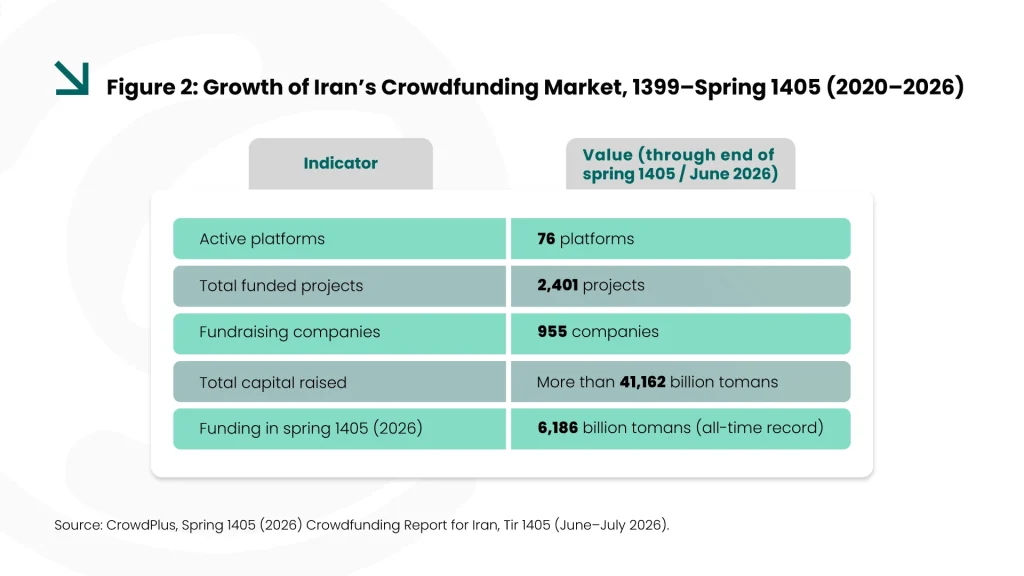
According to CrowdPlus, from the launch of Iran’s crowdfunding market in 1399 (2020/21) through the end of spring 1405 (June 2026), 955 companies raised more than 41 trillion tomans across 2,401 projects. Over the same period, the number of active platforms increased from 5 to 76, reflecting both expanding market infrastructure and growing adoption among businesses and investors.
Market growth has also been accompanied by shifts in investor behavior. According to CrowdPlus reports for spring 1405 (2026), the average proposed return on projects rose from around 30% in 1401 (2022/23) to roughly 45% in spring 1405. However, as market reports emphasize, headline returns should not be the only factor in an investment decision; the quality of each project’s guarantees also plays a decisive role in risk assessment. In spring 1405, most of the market’s funding value was backed by bank payment guarantees or pledged shares, while a smaller share relied on payment guarantees issued by funds.
From a sector perspective, food products attracted the largest share of crowdfunding in spring 1405, followed by basic metals and chemical products. Geographically, the market also remained concentrated in Tehran Province; together, Tehran, Yazd, and Razavi Khorasan accounted for more than 70% of the quarter’s financing volume.
The Future of Crowdfunding in Iran’s Financial Ecosystem
The evolution of financing systems shows that every financial instrument is ultimately a response to a specific economic need. Banks, capital markets, private investors, and crowdfunding are not complete substitutes for one another; together, they form a broader financing stack that businesses can draw on at different stages and under different conditions.
Iran’s experience also suggests that, despite its relatively short history, crowdfunding has already carved out a place in the country’s financial ecosystem. The increase in licensed platforms, the growth in funding volumes, and rising participation from companies and investors indicate that crowdfunding is gradually becoming a bridge between smaller pools of capital and the financing needs of the productive economy.
Sustaining this trajectory, however, will depend on transparency, rigorous project assessment, disciplined risk management, and stronger investor confidence. As these foundations mature, crowdfunding can play a larger role alongside banks and capital markets in financing businesses, supporting production and growth, and broadening public participation in investment.