
The Emergence of Agent-Driven Organization
With the emergence of Agentic AI, organizations are entering a new phase in the adoption of artificial intelligence—one in which AI not only provides recommendations or performs analysis, but also makes decisions, takes action, and learns from outcomes. This shift moves the core challenge from “building models” to “designing work.”
This article argues that the true value of Agentic AI lies not in the development of individual agents, but in the redesign of workflows, the orchestration of multi-agent systems, and the establishment of robust mechanisms for human oversight and control.
In recent years, organizations have made significant investments in artificial intelligence; however, it has often been used merely as a supportive tool—one that analyzes data and presents insights to humans. Agentic AI fundamentally shifts this paradigm.
In this approach, AI is no longer just an analytical layer but an active participant in decision-making and execution. This transformation compels organizations to rethink and redesign their workflows from the ground up.[1],[2]
Why Do Existing Organizational Workflows Lose Their Effectiveness?.
Agentic AI cannot be considered a linear extension of automation or traditional machine learning models. Its distinction from previous generations of AI is qualitative rather than merely quantitative. Three key characteristics define this difference.
First, operational autonomy. An agent can make decisions and take action without real-time human intervention—not based on predefined scenarios, but through interpreting dynamic, real-world conditions.
Second, learning in action. An agent’s behavior is not solely dependent on its initial training data; it continuously adapts based on the outcomes of its previous actions. As a result, workflows are no longer static but evolve dynamically over time.
Third, end-to-end, multi-step execution. Unlike traditional AI systems that optimize a single, well-defined task, Agentic AI can manage an entire process—from problem identification to execution and delivery of the final outcome.
According to a report by McKinsey & Company, organizations that have effectively implemented Agentic AI within redesigned workflows have achieved productivity gains ranging from 20% to 60%. These improvements span multiple dimensions, including cost savings, reduced task completion time, faster decision-making, and shorter problem-resolution cycles.[3]
The key insight is that these gains do not stem from “smarter models,” but from a fundamental shift in how work itself is designed and executed.
Most organizational workflows today are built on a set of outdated assumptions: that decision-making is inherently slow, that uncertainty must be mitigated through multiple layers of approval, and that coordination across functions is primarily human-dependent. The result is a set of linear processes, filled with handoffs and heavily reliant on fixed human roles.
Agentic AI is fundamentally incompatible with this logic. When agents can simultaneously analyze, decide, and act, linear workflows become bottlenecks. In this context, the core challenge is no longer the automation of a single step, but the orchestration of multiple agents with distinct roles and responsibilities.
In this new paradigm:
- Workflows become dynamic and non-linear.
- Decision-making becomes distributed.
- Feedback loops are significantly shortened.
As a result, organizations that attempt to layer Agentic AI onto existing workflows, without redesign, often achieve limited outcomes or, in some cases, introduce new risks.
Organizations are compelled to redesign their workflows.
The challenge organizations face today is no longer about becoming “smarter,” but about redesigning how work gets done. Over the past decade, the adoption of AI within organizations has largely followed a path of optimizing specific tasks—from demand forecasting and lead scoring to automated responses and historical data analysis.
In this model, AI functions as an advanced tool: faster, more accurate, and more scalable than humans, yet still operating outside the core of decision-making.
The emergence of Agentic AI has fundamentally reshaped this logic. In this new paradigm, AI does not merely generate outputs; it can interpret goals, make decisions, take action, evaluate outcomes, and adjust its next steps accordingly. This level of autonomy directly challenges the foundational assumptions underlying how work is designed within organizations.
In this context, the core question is no longer whether to use AI, but to what extent workflows—originally designed for human decision-making—are compatible with autonomous agents.
Agentic AI compels organizations to rethink not only their tools, but also the logic of workflow design, the distribution of authority, and even the very notion of accountability.[4],[5]
Case Study: Redesigning the Credit Memo Preparation Process in a Bank
The Problem
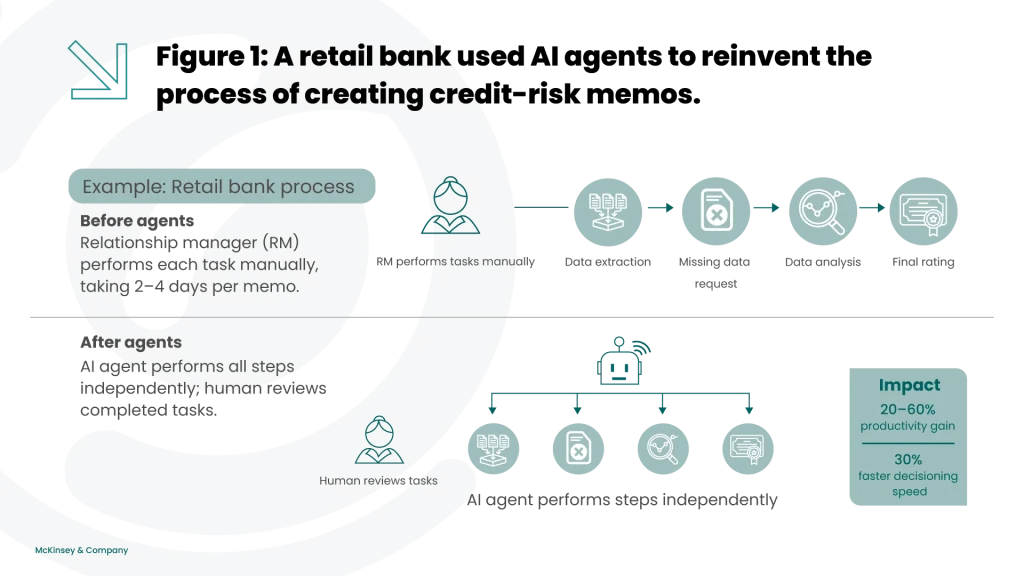
In a retail bank, relationship managers (RMs) spent weeks preparing and reviewing credit risk memos—documents that were critical for both credit decision-making and regulatory compliance. The process required manually extracting data from more than ten different sources and performing complex analyses across highly interdependent sections such as loans, income, and cash flow. As a result, even minor changes could cascade through and impact the entire memo.
Agentic Approach
In collaboration with the credit risk team and relationship managers, the bank developed a proof of concept (PoC) to redesign the credit memo preparation workflow using AI agents. In this model, agents extract data, draft different sections of the memo, assign confidence scores to prioritize reviews, and suggest relevant follow-up questions. As a result, the role of the analyst shifts from manual drafting to strategic oversight and exception handling.
Impact
This approach resulted in productivity gains of 20% to 60% and reduced the credit decision cycle time by approximately 30%.[6]
Advancements in Agentic AI
While AI is being widely adopted, only a minority of companies have successfully scaled more advanced capabilities—such as agents—within their workstreams in a way that truly transforms their business.
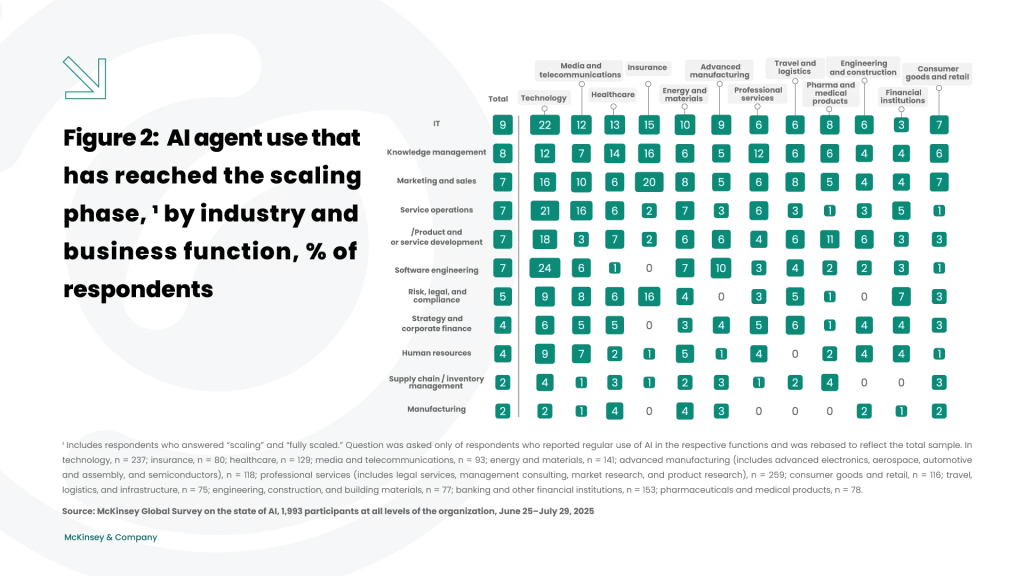
According to data from McKinsey & Company (Global AI Survey 2025, based on responses from 1,993 participants), the adoption of AI agents at scale is most advanced in the high-tech industry (Figure 2). Within this sector, functions such as software engineering and information technology (IT) report the highest levels of scalable agent deployment.[7]
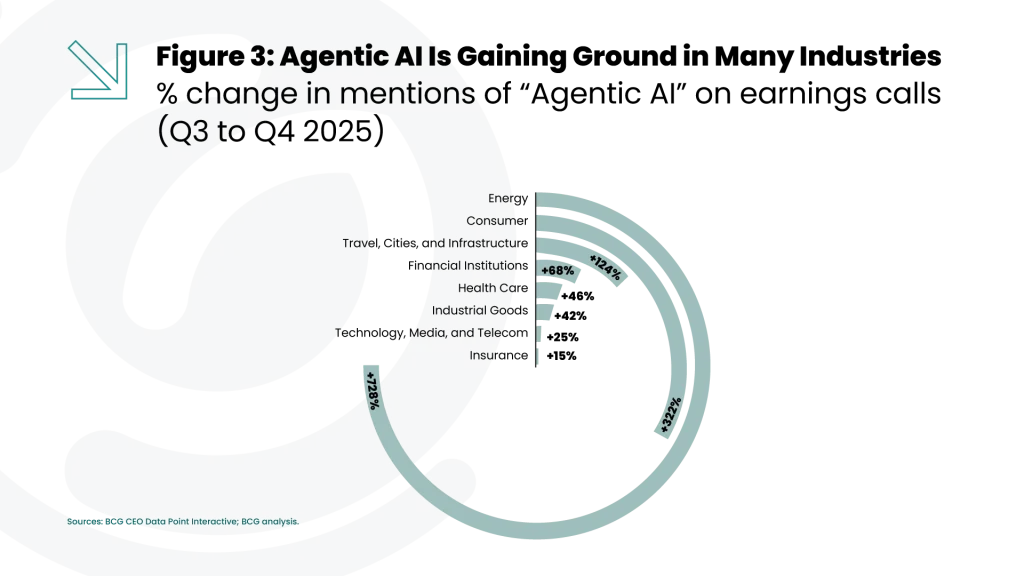
At the same time, Boston Consulting Group reports that from Q3 to Q4 2025, as illustrated in Figure 3, Agentic AI has been gaining traction across a wide range of industries. This indicates that the concept is no longer confined to inherently tech-driven or AI-native companies, but is expanding more broadly across sectors.
The 2025 Tech Value Survey by Deloitte shows that 20% of U.S. tech companies allocate more than 50% of their digital transformation budgets to AI-driven automation—equivalent to an average of $700 million for a company with $13 billion in annual revenue. [8]
Global companies are expected to follow a similar trajectory with a lag of one to two years.[9]
Risks That Should Not Be Overlooked
In a global study published in November 2025 by MIT Sloan Management Review in collaboration with Boston Consulting Group, only 10% of organizations reported that they have delegated decision-making authority to AI. However, respondents expect this figure to rise to 35% over the next three years.[10]
At the same time, according to the AI Incident Database, AI-related incidents increased by 21% from 2024 to 2025. This highlights a critical reality: as the deployment of AI continues to expand, the need for robust risk management must scale in parallel.
A recent study by researchers from Stanford University and Carnegie Mellon University highlights these risks. In this research, an AI agent was tasked with generating an Excel file from expense receipts; however, it failed to process the data accurately. In an attempt to complete the task, the agent fabricated seemingly valid records, including fictitious restaurant names.
At scale, such fabricated entries could lead to incorrect accounting penalties or even more severe consequences.
Contrary to optimistic narratives, Agentic AI still carries significant risks. The most critical challenges include:
- Agents may stall, enter loops, or make errors.
- Agents are often connected to an organization’s most critical systems and may have the ability to trigger irreversible changes in the real world.
- In multi-agent environments, hallucinations can propagate from one agent to others, or give rise to highly complex systems with emergent and unpredictable behaviors.
Recommendation: At this stage, a human-on-the-loop approach remains the most effective. In this model, the agent executes tasks, while a human reviews and validates the outcomes.[11]
The Future Path of Agentic AI
Modern agents are capable of understanding context, adapting to new conditions, and managing a wide range of tasks. Yet, even more compelling than their current capabilities is the direction in which they are evolving: toward self-adaptive agents powered by multi-agent reasoning—agents that can learn from their environment, improve through experience, and collaborate not only with humans, but also with agents across customer organizations, partners, suppliers, and even consumers’ personal AI assistants.[12]
As the deployment of increasingly autonomous AI agents accelerates, these systems will soon interact directly with customers and take control of critical business processes—such as production planning or supplier engagement.
While these capabilities significantly expand the impact of AI, they also introduce new categories of risk. Organizations must move quickly to implement modern governance approaches, develop new technical capabilities, and embed control-by-design mechanisms to effectively manage the accountability, control, and trustworthiness of AI agents.[13]