
For years, two scenarios about AI and work have been repeated. One promises a utopia in which computers lift the burden of toil from our shoulders; the other foretells catastrophe, a wave of unemployment sweeping millions away. But the data from 2025 and 2026 tell a third story, one far more useful to anyone running a business; AI doesn’t eliminate jobs wholesale. It takes them apart and rebuilds them.
The distinction is subtle, but it changes everything. The fundamental unit of work is shifting from the indivisible “job” to the separable ”task”. The title on the business card often stays the same, while the work done at the desk each day is quietly rewritten. This note is about that silent rewriting and how a business, especially an Iranian startup, can come out of it a winner.
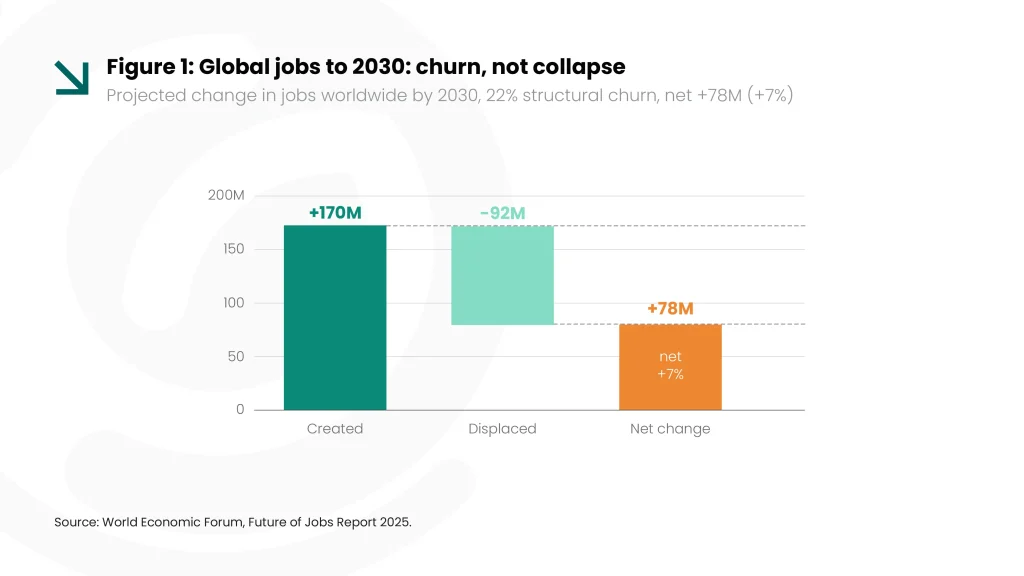
Let’s start with the big picture. The World Economic Forum (WEF) estimates that by 2030, technology alongside demographic shifts will create around 170 million new jobs and eliminate 92 million. The arithmetic yields a positive balance; 78 million net new jobs, or 7% growth. Yet within that same window, a structural churn equal to 22% of all jobs worldwide will take place. This is not the picture of a collapse; it is the picture of a massive relocation.
Why Didn’t the Promised Catastrophe Arrive?
The answer lies in a gap that may be the defining fact of this era; the distance between what AI can do and what it actually does in practice. Anthropic’s research has measured this gap; models are technically capable of performing about 94% of the tasks in computer and mathematical occupations, yet in day-to-day practice only about 33% of those tasks are actually delegated to them. In office and administrative work, the ratio is 90 to 25; in legal work, 80 to 15. Put simply, the fact that AI can do something does not mean the work actually gets handed over to it.
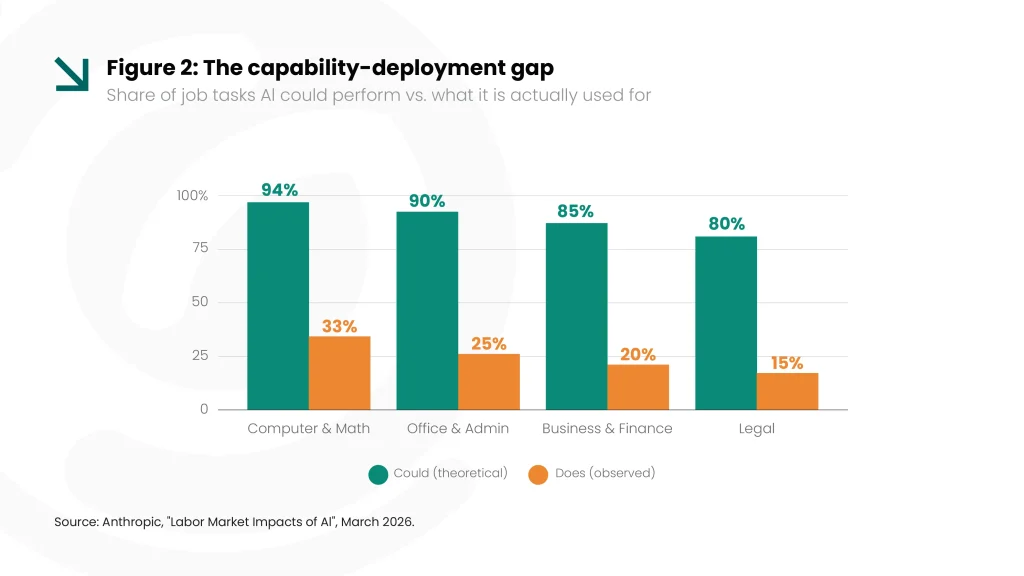
The root of this gap is not weak technology; it is implementation friction. The International Labour Organization (ILO) likewise warns that “exposure to technology” must not be confused with “labor market destiny”. McKinsey puts a number on that friction; today around 88% of organizations use AI somewhere in their operations, yet only 5.5% (109 of 1,993 respondents) say the technology has had a meaningful financial impact — more than 5% of operating profit. The main obstacle? Messy data, outdated processes, and organizations’ natural resistance to change.
Every Job Is a Bundle of Tasks
Crossing this gap requires abandoning an old mental habit; the notion that a job is a monolithic block that either survives intact or vanishes all at once. Leading labor economists propose a sharper lens, the “task-based view”; every job is a bundle of dozens of distinct tasks. AI doesn’t sweep the bundle away in one motion, it opens it up, pulls out the repetitive, rule-bound tasks, and puts the rest back. What remains is a job with yesterday’s name and a brand-new composition. This is precisely what “redefining the job role” means.
The Three Forces Rearranging Jobs
This rearrangement is the product of three colliding forces. The first is automation, rule based, repetitive tasks, answering frequent questions, drafting first versions, summarizing documents, organizing data.
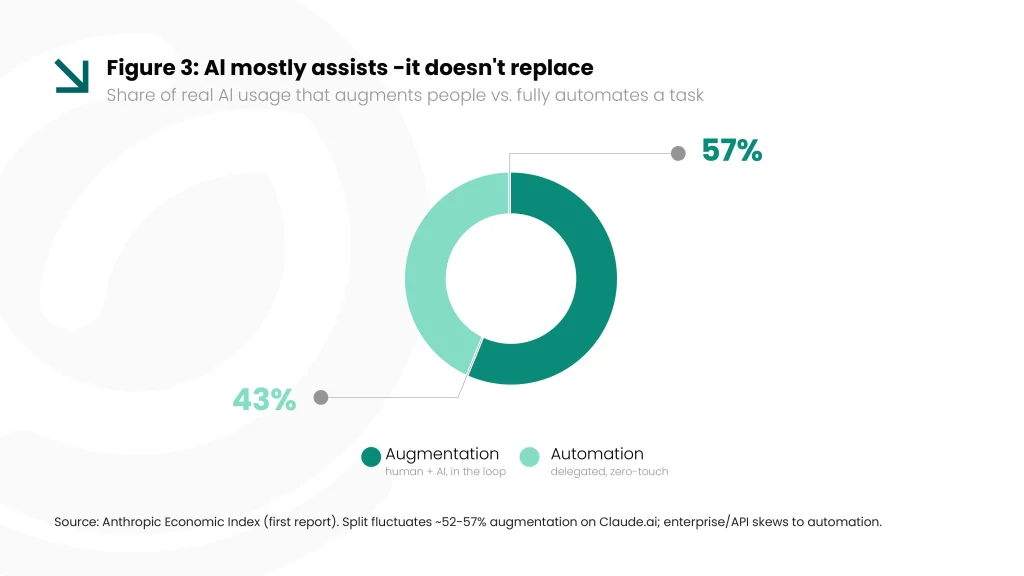
The second force is augmentation. Here AI doesn’t replace the human; it raises the ceiling of what the human can do. According to the Anthropic Economic Index, roughly 57% of real-world usage is augmentation, and only 43% is full automation. The most telling finding is here; in a field study of more than five thousand customer support agents, productivity rose 14% on average and 34% for the least experienced workers. Before AI moves the ceiling, it raises the floor.
The third force is reinstatement; every wave of technology creates roles that did not exist before. David Autor’s research shows that more than half of today’s job titles emerged only after the 1940s.
Redefinition in Practice
The pattern is the same across every role. The software developer, for example, shifts from “code writer” to “engineer of intent and validation”. the agent writes the code, while the human designs the architecture, sets the boundaries, and reviews the output. The marketer moves from executor to director, their value migrating to strategy, taste, and brand voice. The support specialist goes from high volume responder to solver of the hard cases and the moments that demand empathy and negotiation. The analyst, instead of cleaning data, interprets the model’s output and builds a strategic narrative from it. And the recruiter hands the top of the funnel, resume screening and first calls to the machine, focusing instead on closing candidates and assessing cultural fit.
On emerging roles, the hype needs separating from the reality. The “prompt engineer,” hailed as the golden job of 2023, has today become a general-purpose skill rather than a standalone occupation. By contrast, the Forward Deployed Engineer, the person who puts general purpose AI (AGI) to work inside an organization’s real systems, looks like it’s here to stay. According to Indeed data, postings for the role jumped from 643 to more than 5,330 in a single year, April 2025 to April 2026, growth of nearly 730%. Roles like the “AI auditor” are on their way too.
The Hidden Crisis: Declining Entry Level Job Opportunities
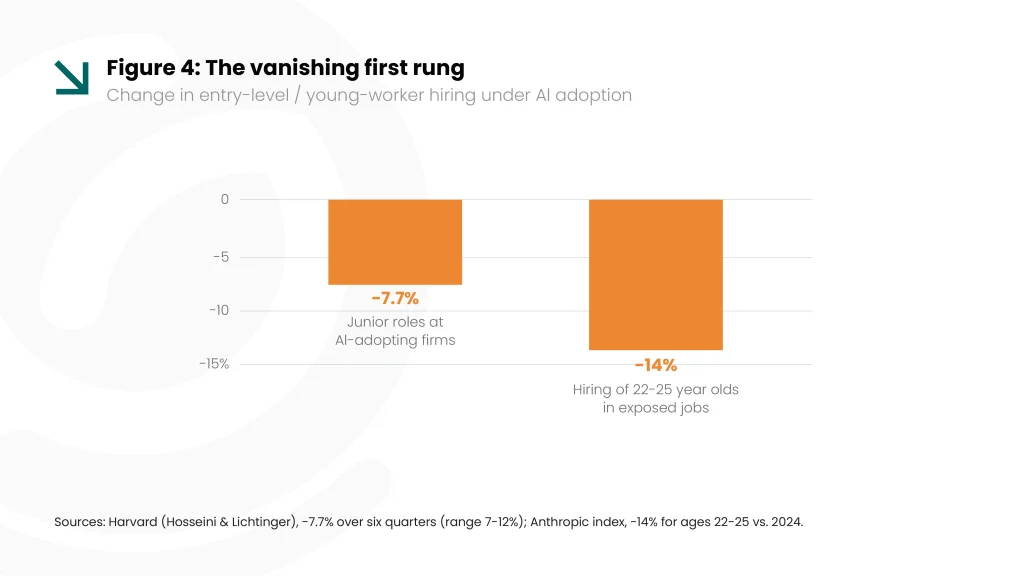
Beneath this relatively optimistic picture, a structural rift is widening. A Harvard study tracking more than 62 million workers across roughly 285,000 firms finds that in companies that adopted AI, junior employment fell about 8% relative to peers over six quarters (a baseline estimate of 7.7%, rising to 12% depending on the sector), while senior employment held steady or even grew. The Anthropic Index likewise records a roughly 14% drop in hiring rates for 22-to-25-year-olds in high exposure occupations compared with 2024.
The logic is brutally simple, AI removes exactly the tasks through which junior staff used to learn the trade. If young people aren’t hired for the simple work, where will the tacit knowledge and judgment that only experience can produce be built?
Skills and the Math of Reskilling
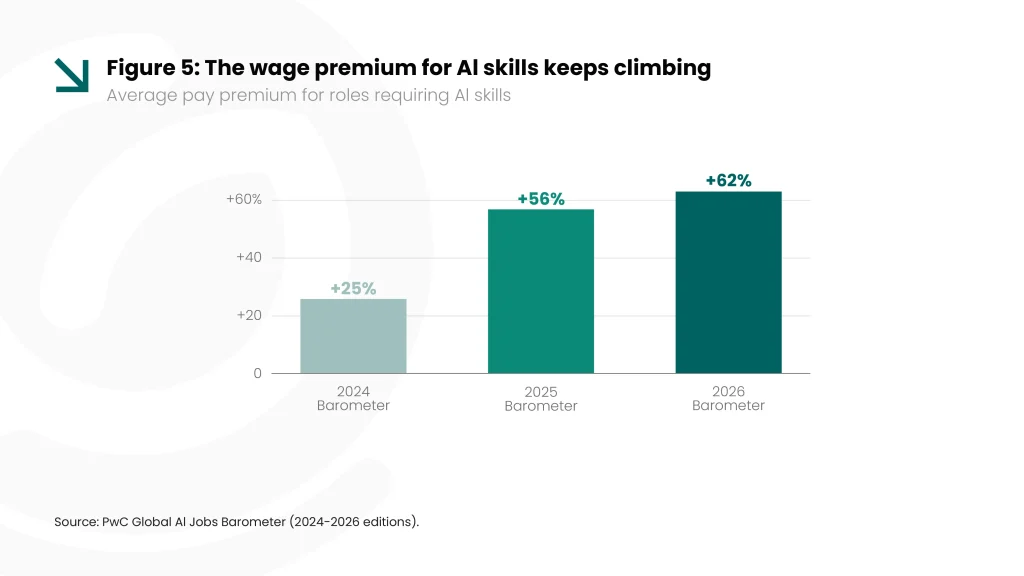
When the task mix changes, skills get repriced too. Codified knowledge, routine data processing, and standard text are becoming cheap; analytical thinking, complex problem solving, adaptability, and deeply human skills like empathy and emotional intelligence are becoming expensive. Most telling of all, “AI literacy” the ability to direct a model and review its output now commands a striking premium. According to the PwC Global AI Jobs Barometer, positions requiring specialist AI skills carried a wage premium of up to 25% in some markets in 2024. The global average of that gap was reported at around 56% in the 2025 edition and around 62% in the 2026 edition. These figures come from comparing similar job postings, not from tracking pay raises for any particular individual.
For managers, a simple equation breathes beneath these shifts. Reskilling is usually cheaper than replacing. Economically upgrading an existing employee’s skills usually makes more sense than swapping them out. A joint WEF/BCG estimate puts the cost of reskilling one worker at around $24,800, while the combined costs of separation, recruiting, training, and bringing a new hire to full productivity can exceed $62,000. This aligns with Gallup’s estimate that replacing an employee costs the equivalent of 50% to 200% of their annual salary, depending on the type and level of the position. Therefore, it is no surprise that according to the WEF, about 85% of employers worldwide plan to invest in upskilling their current workforce rather than replacing it.
The AI-Native Company: Tokens Instead of Headcount
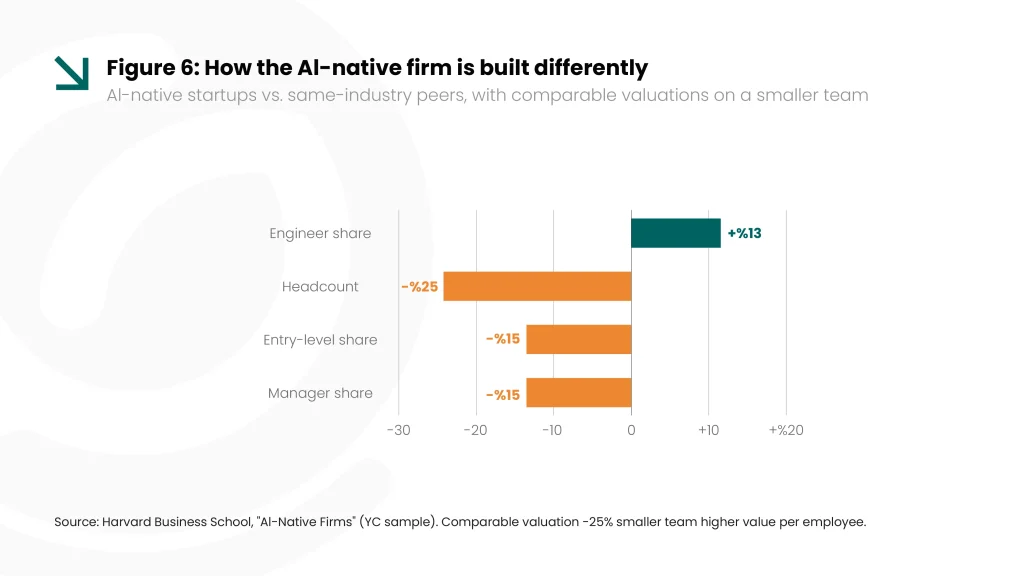
For founders, AI is not just a capability to bolt onto the product; it is the catalyst for an entirely new organizational architecture. According to Harvard Business School data on a sample of Y Combinator startups, “AI-native” companies are on average about 25% smaller than their industry peers; their share of engineers is about 13% higher; their shares of junior staff and middle managers are each about 15% lower; and their hierarchies are flatter, fewer middle managers, and a shorter distance between the execution team and senior decision makers. The key point is their valuations remain on par with their peers, which means the value per employee is effectively higher. Y Combinator has distilled this into a slogan “tokenmaxxing” instead of headcount maxxing, before adding people, scale output with compute and AI tokens, replacing the fixed cost of salaries with the variable cost of machines.
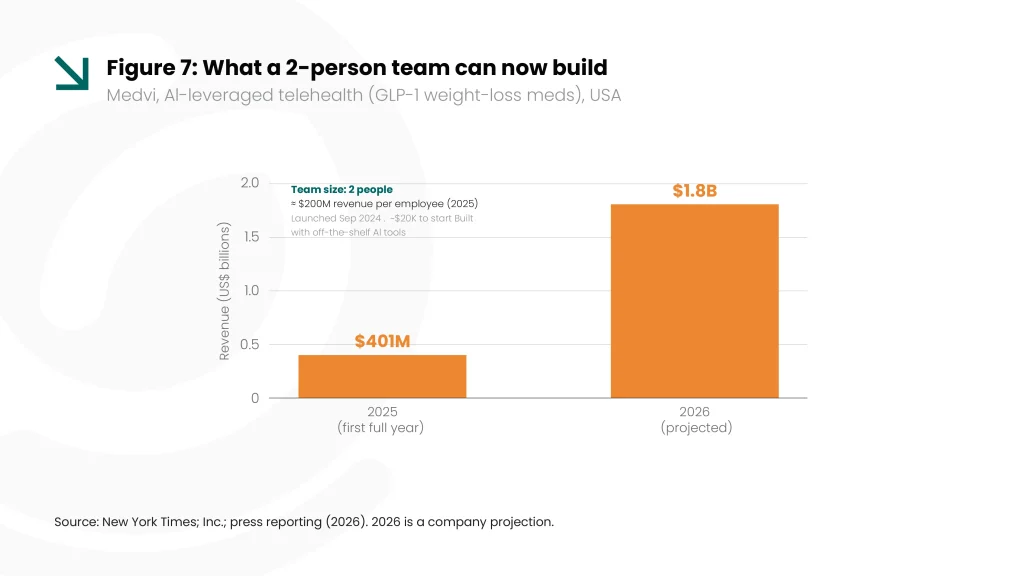
This model is no longer a hypothesis; its real world proof is Medvi. In September 2024, Matthew Gallagher with about $20,000 and only his brother alongside him, a team of two launched a digital health platform in the GLP-1 weight loss drug space (the Ozempic and Wegovy family). Coding, content production, ad creation, customer replies, and performance analysis were handled by off the shelf AI tools, and anything that couldn’t be digitized was outsourced. His own words say it best, “This isn’t an AI company, but I built it with AI.” The results were remarkable. 300 customers in the first month, another thousand in the second, and in the first full year of operation (2025), revenue of $401 million with more than 250,000 customers, nearly $200 million per person. The company’s projection for 2026 is to cross the $1.8 billion mark.
But Medvi should not be mythologized. Reports indicate its support chatbot sometimes gave incorrect information, invented prices, or answered vaguely, and the company also ran into trouble with advertising and public relations. The bigger lesson is that an ultra-lean structure brings fragility along with speed. When nearly everything depends on two people and on third party infrastructure, even a small error can prove costly. The model is powerful, but it is not exempt from corporate governance and risk management. Its implications for hiring are transformative too the first hires must be senior and multi skilled, with the ability to judge precisely which tasks AI can be trusted with and which decisions require human judgment and sign off.
The Iranian Lens: Constraints, Brain Drain, and Homegrown AI
The Iranian business plays on a different field, and a wholesale copy of the Silicon Valley playbook in Tehran is a recipe for failure.
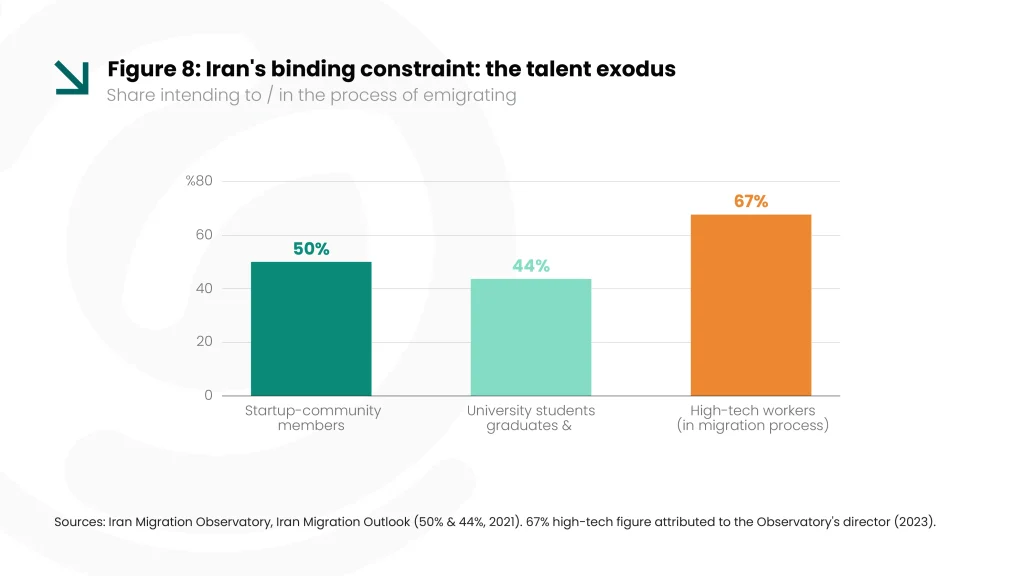
Global cloud infrastructure like AWS, Google Cloud, Azure is restricted for Iranian companies. According to reports, sourcing GPUs on the gray market can cost up to three times the global price. An aging power grid and a lack of cooling infrastructure put a physical ceiling on large data centers, and real investment lags behind regional neighbors. But the main threat lies elsewhere, brain drain. According to the Iran Migration Observatory, about 50% of startup ecosystem participants and 44% of students and graduates intend to emigrate (figures from the 2021 report; more recent estimates point to a share of up to roughly 67% among tech workers). Even those who stay often turn to “virtual migration”, remote work for foreign employers at hard currency wages, which pushes small domestic companies out of the market for top tier talent.
AI’s limited performance in Persian is a serious challenge. In the FarsEval evaluation, many of the models examined scored below 50%, and even leading global models on the Khayyam (PersianMMLU) benchmark, the Persian version of MMLU, still show a noticeable gap against the performance of Persian speaking users. The realistic path is not necessarily developing large, costly foundation models. smaller, open source models adapted to the Persian language and the needs of the Iranian market can do the job.
Out of these constraints, three strategic paths take shape. The first is to sidestep direct competition in building foundation models and focus on the role of the “applied integrator”; selecting, fine tuning, and deploying open-source models for well-defined problems such as Persian digital health, agriculture, supply chains, and compliance with Iran’s financial regulations.
The second path is building asymmetric productivity. A team of three to five people can use intelligent agents to automate parts of marketing, customer support, and software development expanding operational capacity and revenue without a proportional increase in headcount.
The third path is building competitive advantage on proprietary data. High quality, legally sound datasets tailored to the Iranian context, Persian conversational commerce, consumer behavior, or domestic supply chain data are assets that global players can neither easily access nor reproduce without understanding the context. Iran’s experience with the spread of information technology also shows that technology can narrow regional gaps; AI tailored to the country’s needs has the capacity to create a similar leap in business productivity.
The Gate Swings Wider: An Opportunity for Founders and Golrang Ventures
Medvi is signal of a structural shift. The wall that stood between an idea and a revenue generating company has come down; capital, teams, and multi-year cycles are being compressed into months. For Iran, this shift carries special meaning. In a market where capital is scarce, senior talent is hard to find under the shadow of brain drain, and global infrastructure is closed off, the AI-native model may be the most realistic path to building a company. In this era, then, expect more founders who build real businesses with smaller teams and less capital.
For an investor, this shift rewrites the evaluation scorecard. Headcount and burn rate no longer say what they said yesterday; a three-person team with real revenue can be worth more than a thirty-person team with the same revenue.
And here the strategic importance of a corporate venture capital firm (CVC) like Golrang Ventures comes into focus. An AI-native team can build a product and automate operations, but it cannot conjure a distribution network, brand trust, shelf presence, regulatory navigation, and a supply chain out of nothing overnight. These are precisely the assets that half a century of Golrang Group experience and its more than 100 brands provide. And that makes Golrang Ventures’ offer, capital plus market access, brand, and industrial experience, all the more valuable. The synergy even has a case in point, Medvi was a digital health business, and Golrang is already present in pharmaceuticals, health, consumer goods, cosmetics, agriculture, and fintech. Golrang Ventures is looking for exactly these teams, founders who draw speed and agility from AI, alongside the Golrang Group, which opens the path to market and repairs the AI-native model’s fragility, the gaps in governance, risk management, and operational backbone. Here, founders who want to change the world get the chance to do it.
The Ladder Moves Up
AI doesn’t take our jobs; it moves the tasks around. Repetitive, rule bound work is getting cheap, while decision making, contextual understanding, taste, relationships, and the art of asking the right question are getting expensive. The right question is not “Which jobs do we cut?” It is “How do we rearrange each role so that human and machine each do what they do best?” The loser is not the one who joins this wave late; the loser is the one who denies the redefinition. At Golrang Ventures, we believe the future of work will be built by the companies that learn soonest how to seat humans and AI side by side. Where in your own team have you begun this redefinition?