Navigating the Journey from Hype to Real Technology Value
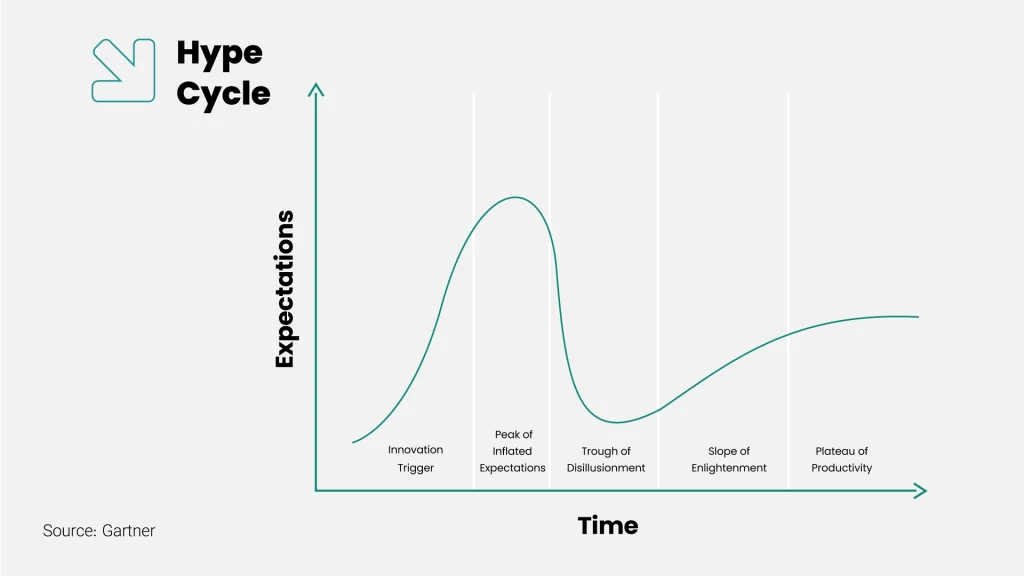
The Gartner Hype Cycle is one of the most trusted frameworks for evaluating and managing emerging technologies. It illustrates the evolution of a technology—from its initial emergence to maturity and sustained productivity—across five distinct stages. The model highlights a fundamental reality: every innovation passes through a period of inflated expectations and subsequent disillusionment before its true value becomes clear.
The primary purpose of this framework is to help leaders distinguish between media-driven excitement and actual technological value—a distinction that carries strategic importance for executives, investors, and innovation teams. Today, forward-leaning organizations rely on this model to monitor technological trends, time their investments, and make informed decisions throughout their digital transformation journeys.
The following sections walk through the five stages of the Hype Cycle.
Stage 1: Innovation Trigger
The first phase of the Gartner Hype Cycle, the Innovation Trigger, begins when a breakthrough technological development captures widespread attention. This may stem from a scientific discovery, a major technical advancement, or the introduction of a transformative product. At this point, media interest accelerates, investors take notice, and innovation-driven organizations begin exploring the technology’s potential.
During this early phase, new startups emerge, venture capital activity intensifies, and leading companies launch their initial pilot projects to test feasibility and uncover early use cases.
Yet despite the enthusiasm surrounding these technologies, evidence of commercial viability remains limited. As a result, many innovations sit at the intersection of promise and uncertainty; a space filled with opportunity but equally rich in risk.
According to Gartner’s latest analyses, technologies such as Digital Humans, Self-Integrating Applications, and Quantum Machine Learning are among the most prominent examples currently positioned in the Innovation Trigger phase. These technologies are on the verge of a conceptual leap, drawing attention from investors, research institutions, and governments alike. However, they still face a significant gap before reaching the level of maturity required for large-scale industrial adoption.
Similarly, quantum technology remains in the early stages of the Hype Cycle. As the field transitions from research toward industrial deployment, it is rapidly emerging as a potential pillar of global technological competition; one expected to shape strategic priorities across industries by the early 2030s.
The Innovation Trigger marks the beginning of the technology maturity journey; a phase in which early ideas and future visions take shape, but the path toward broad adoption and sustained value creation remains long, uncertain, and highly dynamic.
Optimal Organizational Actions in the Innovation Trigger Phase
- Strengthen technology foresight and the ability to monitor emerging trends
Industrial organizations must build the capability to track technological developments, analyze weak market signals, and identify emerging technologies that could impact their business models.[1] Establishing continuous foresight structures within strategy or innovation units enables systematic assessment of technological opportunities and threats. As Gartner notes, the goal in this phase is sense-making, not scaling.[2]
- Establish a risk management and early-stage evaluation framework
Given the high level of uncertainty in this phase, organizations need a structured framework to evaluate the risks, costs, and potential benefits of new technologies. Gartner recommends that when key questions about commercial viability remain unanswered, organizations should avoid rushing in and instead wait for clearer evidence from early market leaders before scaling their investments. [3]
Stage 2: Peak of Inflated Expectations
In this stage, media attention and public excitement surrounding an emerging technology reach their highest point. New entrants and investors rush in to capitalize on the momentum, and the market becomes saturated with ambitious promises and forward-looking narratives.
This phase typically emerges when a handful of early successes create the perception that the technology is on the verge of transforming entire industries, even though real evidence of effectiveness and scalability remains limited.
As the media amplifies these initial wins, the market’s expectations begin to outpace the technology’s actual capabilities. Due to the lack of sufficient empirical data, many initiatives fail to deliver meaningful results, setting the stage for the next phase: the Trough of Disillusionment.
Technologies such as NFTs, Data Fabric, and Decentralized Identity are prominent examples identified by Gartner in recent reports. Despite attracting significant investment and media attention, these technologies have yet to demonstrate consistent commercial viability or long-term operational value.
Overall, this phase reflects the widening gap between the theoretical promise of an innovation and its practical ability to address real business needs. Effective organizations in this stage avoid being swept up by the hype. Instead, they focus on critical data analysis, targeted experimentation, and the creation of realistic performance benchmarks.
For large enterprises and multi-industry corporations, the most effective strategy during the Peak of Inflated Expectations is smart hype management; neither rejecting the technology outright nor entering prematurely without adequate validation.
Optimal Organizational Actions in the Peak of Inflated Expectations
- Create controlled experimentation environments and low-risk pilot initiatives
When there is no clear evidence of immediate profitability from emerging technologies, large organizations should advance from ideas to proof-of-concept (PoC) through small-scale pilot projects and targeted collaboration with startups. Establishing internal startup units and leveraging models such as Venture Client or Venture Building are among the most effective ways to test new technologies in a controlled environment with limited risk. [4]
- Strengthen alignment between technology, business, and executive leadership
Emerging technologies generate value only when they are aligned with the organization’s operational and commercial priorities. Leading companies build structured, ongoing channels of communication between R&D, business units, and senior leadership to ensure that technology decisions support the broader strategic direction of the organization.
As Gartner highlights, one of the core purposes of the Hype Cycle is precisely to facilitate this alignment among technology and business stakeholders.[5]
Stage 3: Trough of Disillusionment
The Trough of Disillusionment is the point at which early excitement fades and initial users begin to report that the technology’s real-world performance falls short of its early promises. Return on investment (ROI) is lower than expected, and technical issues, infrastructure limitations, and execution challenges start to surface.
During this phase, many early vendors exit the market, investors become increasingly cautious, and public attention significantly declines. Only companies with a deep understanding of the technology, those focused on improving quality and redefining use cases, are able to move beyond this phase and advance toward the Slope of Enlightenment. [6]
Artificial intelligence is one of the most notable examples of a technology currently navigating this stage. After an intense period of hype and elevated expectations, AI and its various models and applications have now entered a phase of realism and effectiveness assessment. Reports show that most organizations have not yet realized the anticipated returns from their AI investments, underscoring the need to rethink implementation strategies and value management.
Evaluating emerging technologies through the lens of the Hype Cycle, particularly in the case of AI, enables organizations to analyze applications and business models logically and step by step. This structured approach helps companies move beyond market excitement and adopt strategies that reflect the actual maturity level of the technology at each stage.
Optimal Organizational Actions in the Trough of Disillusionment
- Balance learning with cost discipline
Rather than abandoning initiatives altogether, organizations should reallocate resources toward analyzing failures, improving data quality, and redesigning practical use cases. This balanced approach helps lay the foundation for the technology’s maturity in the later stages of the Hype Cycle. [7]
- Focus on real performance evidence and institutional learning
Building an internal knowledge base that captures the outcomes of failed or partially successful projects enables organizations to leverage organizational learning in future decisions. During this phase, the focus should shift from external promotion to internal learning and redefining the value pathway. [8]
- Maintain relationships with remaining vendors and evaluate second-generation solutions
As weaker players exit the market, stronger vendors begin developing second-generation products. Forward-looking organizations treat this stage as an opportunity for strategic partnerships, renegotiation, and gaining early-mover advantages. [9]
In the Trough of Disillusionment, the technology moves from hype to realism. The market consolidates, capable vendors remain, and learning-oriented organizations rise to the top. For large enterprises, the most effective response is to analyze performance objectively, invest selectively in areas with improvement potential, and stay prepared for the second wave of technological growth.
Stage 4: Slope of Enlightenment
In this stage, organizations and early adopters that have experienced the real benefits of the technology begin to move from experimentation toward purposeful adoption. Market attention shifts from bold promises to productivity gains, standardization, and the development of sustainable economic models.
Vendors introduce second- and third-generation versions of their products, and a growing number of companies allocate budget for broader pilot initiatives. Conservative organizations remain cautious, but momentum increasingly moves toward structured, evidence-based deployment.[10]
Examples of technologies in this stage include:
- · Text Analytics
- · Social Analytics
- · Event Stream Processing
Optimal Organizational Actions in the Slope of Enlightenment
- Invest selectively in proven use cases
At this stage, organizations should shift their focus from conceptual testing to targeted implementation in areas where there is clear evidence of practical success. This approach increases returns and accelerates organizational learning. [۱۱]
- Develop industry-level collaboration models
By forming alliances and cross-organizational partnerships, companies can contribute to standardization efforts and the development of shared infrastructure. Such collaboration reduces the risks and costs associated with technology adoption and helps smooth the path toward broader market maturity.
- Gradually integrate the technology into core operations
Mature organizations begin embedding the technology into their core business processes, from marketing and operations to supply chain management. At this point, the technology transitions from an experimental tool into a sustained competitive advantage.
Stage 5: Plateau of Productivity
A technology reaches the Plateau of Productivity when it moves beyond the innovation and experimentation phase and becomes part of the mainstream market. At this point, there is sufficient empirical evidence of its performance, standards and best practices have been established, and its commercial value is measurable for most organizations. Adoption accelerates, vendor stability becomes clearer, and deployment costs decline. As a result, the technology not only achieves operational maturity but also becomes a foundational driver of organizational competitiveness. [12]
Optimal Organizational Actions in the Plateau of Productivity
- Standardize and institutionalize processes
Organizations should focus on integrating the technology into core business processes, developing standardized procedures, and transferring knowledge to operational teams. This approach increases efficiency, reduces costs, and reinforces long-term competitive advantage.
- Prioritize scalability and economic returns
Technologies that reach the Plateau of Productivity enter a phase where return on investment (ROI) can be measured and optimized with precision. Sustaining competitive advantage requires a strong emphasis on data analysis and continuous improvement anchored in key performance indicators (KPIs).
- Expand cross-organizational and ecosystem partnerships
Mature technologies, particularly in data and analytics, create the greatest value when deployed within industry ecosystems and cross-organizational collaborations. At this stage, organizations should shift from a narrow focus on ownership to value and data sharing, strengthening collective resilience and enabling broader innovation.
Beyond the Hype: Moving Toward Real Technological Impact
The leading organizations of the future will be those that approach the Hype Cycle with a sharp, analytical mindset, distinguishing genuine opportunities from short-lived waves of excitement. Success in the era of innovation is no longer defined by the mere identification of emerging technologies; it depends on the ability to convert innovation into sustainable competitive advantage, strengthen execution capabilities, and maintain resilience amid rapid market shifts.
Value creation in this environment does not emerge from technology hype alone. It stems from a deep understanding of how technology aligns with real business needs and organizational culture. Companies that strike the right balance between creativity, strategy, and execution will stand at the forefront of industrial transformation, generating long-lasting economic and societal impact from the next waves of technological advancement.